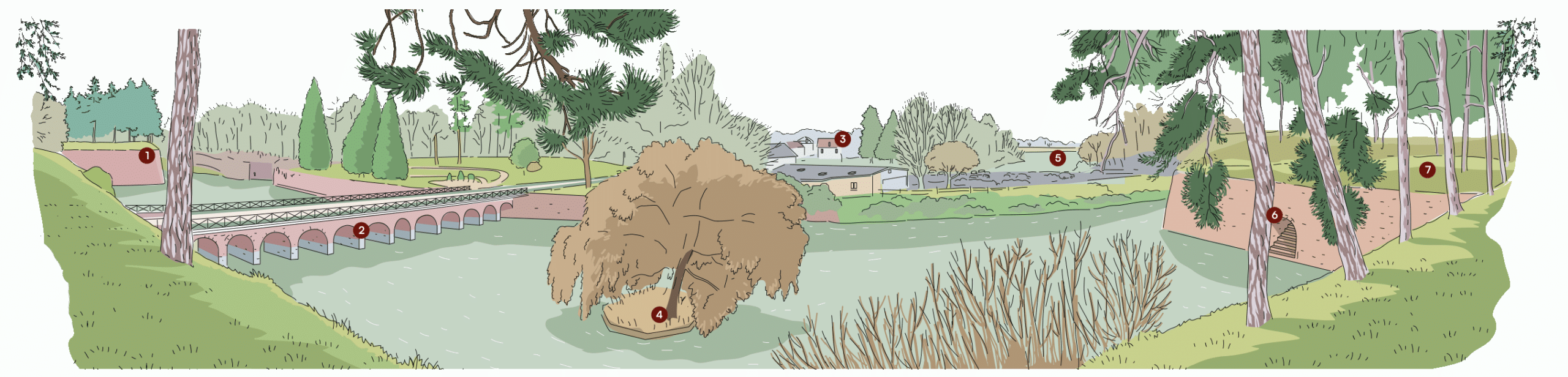
Sur la gauche vous apercevez le bastion Impérial 1 construit au XVIe siècle en l’honneur de Charles Quint lorsque Le Quesnoy était sous domination espagnole. Ensuite le pont Fauroeulx 2, pont dit dormant, c’est-à-dire fixe, qui permet l’accès à la ville par la porte du même nom. Il est en brique et grès et parcourt le plan d’eau dit du Lac Vauban où les cygnes ont élu domicile sur l’îlot en face de vous.
4 L’île aux canards
6 Ancien Hôpital de siège
Au deuxième plan et au loin vous voyez le faubourg Fauroeulx 3 protégé par des murailles extérieures à la ville dite close que l’on appelle « ouvrage à cornes ». Ces dimensions exceptionnelles en font un ouvrage défensif unique. Le faubourg est baigné sur son flanc par l’étang du Pont Rouge 5, véritable réserve d’eau pour les fossés des remparts en cas de siège. Cet étang est alimenté par le canal de l’Ecaillon spécialement conçu à cet effet.
A droite, le bastion Vert 7 s’ouvre à votre regard. Plus petit des bastions de la cité, il est cependant assez extraordinaire car il abritait un hôpital de siège où les soldats blessés ou malades étaient soignés. La poterne (ouverture dans la muraille) que vous apercevez permettait l’accès des marchandises ou l’évacuation en cas de siège.
Les arbres plantés sur le sommet des murailles ont aujourd’hui un aspect décoratif mais leur vocation première dans la défense de la ville en cas d’attaque était de créer un « écran » empêchant l’ennemi de régler des tirs d’artillerie sur des bâtiments précis.
On the left, you can see the Imperial Bastion 1, built in the 16th century in honor of Charles V when Le Quesnoy was under Spanish rule. Next comes the Fauroeulx Bridge 2, a so-called “fixed” bridge, meaning non-drawbridge, which provides access to the town through the gate of the same name. Built of brick and sandstone, it crosses the body of water known as Lake Vauban, where swans have made their home on the small island facing you.
4 Duck Island
6 Former Siege Hospital
In the background, further away, you can see the Fauroeulx suburb 3, protected by outer fortification walls beyond the enclosed town, known as a “hornwork.” Its exceptional dimensions make it a unique defensive structure. The suburb is bordered on one side by the Pont Rouge pond 5, a true water reserve for the moat surrounding the ramparts in the event of a siege. This pond is supplied by the Ecaillon canal, specially designed for this purpose.
To the right, the Green Bastion 7 comes into view. Although it is the smallest bastion of the town, it is nevertheless quite remarkable because it housed a siege hospital where wounded or sick soldiers were treated. The postern gate (an opening in the wall) that you can see allowed goods to enter or people to evacuate during a siege.
The trees planted on top of the ramparts now appear decorative, but their original defensive purpose was to create a “screen” preventing the enemy from accurately targeting specific buildings with artillery fire during an attack.
Aan de linkerkant ziet u het Keizerlijk Bastion 1, gebouwd in de 16e eeuw ter ere van Karel V toen Le Quesnoy onder Spaans bewind stond. Vervolgens ziet u de Fauroeulx brug 2, een zogenaamde vaste brug, die toegang geeft tot de stad via de poort met dezelfde naam. De brug is gebouwd van baksteen en zandsteen en loopt over het waterbekken dat bekendstaat als het Vaubanmeer, waar de zwanen hun thuis hebben gevonden op het eilandje recht voor u.
4 Eendeneiland
6 Voormalig belegeringshospitaal
Op de achtergrond, in de verte, ziet u de voorstad Fauroeulx 3, beschermd door buitenmuren buiten de ommuurde stad, een zogenaamd “hoornwerk”. Door zijn uitzonderlijke afmetingen is dit een uniek verdedigingswerk. De voorstad wordt aan één zijde omringd door de vijver van Pont Rouge 5, een echte waterreserve voor de grachten van de stadswallen in geval van belegering. Deze vijver wordt gevoed door het kanaal van de Ecaillon, dat speciaal voor dit doel werd aangelegd.
Rechts opent zich het zicht op het Groene Bastion 7. Hoewel dit het kleinste bastion van de stad is, is het toch bijzonder omdat er een belegeringshospitaal was gevestigd waar gewonde of zieke soldaten werden verzorgd. De poterne (een opening in de stadsmuur) die u ziet, maakte de aanvoer van goederen of evacuatie mogelijk tijdens een belegering.
De bomen die boven op de vestingmuren zijn geplant, hebben tegenwoordig een decoratieve uitstraling, maar hun oorspronkelijke functie was defensief: zij vormden een “scherm” dat